
PVC Flooring Technical Guide: Customization Parameters and SGS RoHS Evidence for EU Projects
EU-bound PVC flooring orders rarely fail because the product does not exist. They fail because a project brief written in performance language meets a production line that works in parameter language, and nobody converts one into the other. A brief that asks for durable, compliant flooring for a 60-room refurbishment cannot be produced. A brief that states PVC floor tile, 1.5 mm, 60 x 300 cm, matte surface, EU-market RoHS documentation attached can be quoted, sampled and shipped.
This guide is that conversion layer. It explains how to turn an EU project requirement into locked PVC flooring parameters, which parts of a specification are customizable on model WB-PVC, and how to verify the SGS RoHS evidence that supports EU market placement before an order is confirmed.
Direct answer. Model WB-PVC is a PVC floor tile supplied at 1.5 mm thickness in 40/60/120*300 cm sizes, with customization supported across size, thickness, pattern, surface and packaging. The SGS RoHS Test Report in the manufacturer documentation is issued by SGS-CSTC, applies to the EU market, and cites RoHS Directive (EU) 2015/863. The report on file covers the 3D WALL BRICK (PE material) product, so a buyer specifying WB-PVC should confirm the report declared product scope, and the exact model it names, as part of the document review described below.
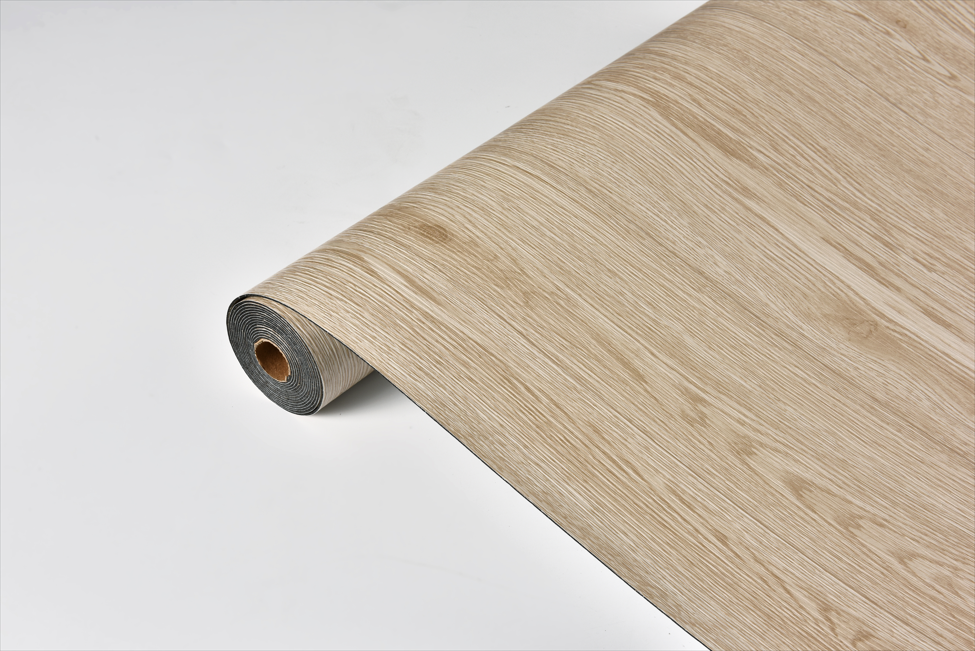
Cover: PVC floor tile model WB-PVC, the base product this specification guide is built around.
The Specification Gap: Why EU Briefs and Factory Quotes Disagree
Three specific mismatches cause most of the friction on EU-bound PVC flooring orders.
Unit and format mismatch. Interior designers and retailers often specify in imperial formats, and marketplace searches reflect that with terms such as 6 x 36 inches PVC flooring. Production data for model WB-PVC is held in metric, with available sizes of 40/60/120*300 cm. Neither system is wrong, but the conversion has to happen at the quotation stage rather than at the packing stage.
Performance vocabulary that is not a parameter. Buyers search using outcome words: fire-resistant PVC flooring, wear-resistant PVC flooring, waterproof PVC flooring, anti-static PVC flooring, anti-slip PVC flooring, light weight PVC flooring, hospital-grade PVC flooring, kindergarten PVC flooring, workshop PVC flooring. A factory cannot manufacture an outcome. It manufactures a PVC floor tile with a defined thickness, surface, base construction and size, and the performance behaviour follows from those choices. When a buyer sends an outcome word as a specification, the supplier either guesses or refuses.
Document scope mismatch. This is the most expensive of the three. A buyer receives a compliance document that is genuine, correctly issued and correctly worded, but written for a different product in the supplier range. The document is not fraudulent; it is simply out of scope for the ordered model. That gap is usually discovered by a customs broker, an importer QA team or a project client, at which point the container is already in transit.
The remedy for all three is the same: convert the brief into locked parameters, then verify that the document pack names those same parameters.
Industry Background: A Deep Supply Base Raises the Bar on Precision
Vinyl flooring demand continues to expand. Grand View Research estimated the global vinyl flooring market at USD 28.0 billion in 2026, projecting USD 41.5 billion by 2033, a compound annual growth rate of 5.8% over that period. Vinyl flooring in that definition covers LVT, VCT and sheet formats.
Supply is concentrated. According to OEC trade data for HS code 391810 (floor, wall and ceiling coverings of vinyl chloride polymers), China was the leading exporter in 2024 with exports valued at USD 4.97 billion, ahead of Vietnam at USD 1.81 billion and South Korea at USD 820 million.
Two conclusions follow for an EU buyer. First, availability is not the constraint; the supply base is deep and competitive. Second, price competition has flattened the visible differences between suppliers, which pushes the real differentiation into specification precision and documentation accuracy. The buyer who can write an unambiguous parameter sheet, and who knows which documents must name which model, gets a smoother project at a comparable price.
The Base Product: PVC Floor Tile Model WB-PVC
Shanghai Yuanguan Rubber Plastic Co., Ltd. is a decorative materials manufacturer located at Building 5, No.6066, Songze Road, Qingpu District, Shanghai, China, established in 2005, whose product line is marketed under the SXP Wall Panel brand. The company manufactures wall stickers, wallpaper, flooring and foam materials, and reports that export business accounts for 90% of total sales, with EU, USA, Asia and South America as its main markets, supplying retailers and wholesalers in more than 80 countries and regions.
Model WB-PVC sits inside that range as a PVC floor tile: PVC material, 1.5 mm thickness, available sizes of 40/60/120*300 cm, positioned for building materials, home and garden and interior decoration applications.
Three manufacturing facts matter when a buyer is deciding whether a custom specification is realistic. The company operates a 7,000-square-meter intelligent factory with automated production facilities, alongside a manufacturing facility covering 8,000 square meters, and reports an annual production capacity of 75,000,000 units. It holds ISO9001 quality management system certification and 48 patented technologies. Its team is approximately 150 staff, with a broader professional group of 200 members covering R&D, QC, production and sales, including an R&D team of 5 engineers.
The practical meaning for an EU buyer is that customization is a scheduled production activity, not an exception. A supplier without this structure negotiates every non-standard size; a supplier with it locks the parameter and runs the batch.
Five Customization Dimensions You Can Lock Down
Customization on this flooring line is supported across five dimensions: size, thickness, pattern, surface and packaging. Each one has to be locked to a value. Locking four of five is the most common cause of a re-sampling loop, because the unlocked dimension is exactly the one the QC team measures.
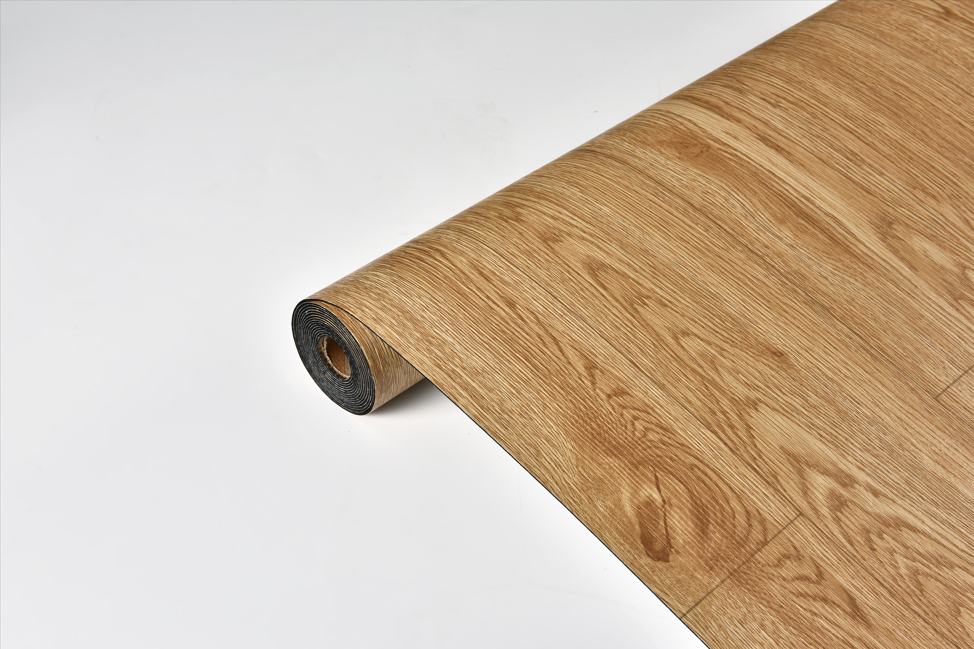
Supporting: the five customization dimensions that must be locked to values before an EU order is confirmed.
1. Size
Standard availability is 40/60/120*300 cm. The translation rule is simple: choose the size that minimizes offcuts in the actual room module and still fits the pallet and container plan. A 300 cm length suits corridor and open-floor layouts with few joints; a narrower width suits small hotel bathrooms and service areas. Where a client has specified an imperial format in the design drawings, resolve the conversion at the proforma invoice stage, in writing, rather than treating the metric tile as a substitute.
2. Thickness
Model WB-PVC is supplied at 1.5 mm. Thickness affects stiffness, weight per square meter, pallet handling and cost. It is not a substitute for base preparation: the installation guidance for this range requires a flat, dry base free of dust and grease, and a floor base with adequate strength and no hollow spots. A powdery, sandy or loose surface is excluded regardless of thickness. Write thickness as a locked number and agree how it will be verified on the incoming inspection.
3. Pattern
Visual categories commonly requested for European interiors include wood-grain, stone-grain, parquet-pattern and carpet-pattern finishes. Two pattern properties affect the commercial outcome: directionality, which changes how the floor reads across a large open space, and repeat length, which changes installation loss. Confirm the pattern against a physical sample rather than a screen image or a digital file, because colour rendering differs between devices.
4. Surface
Surface finish decides how the floor behaves in daylight and in humid zones. A matte-surface finish reduces glare in retail and office interiors and hides scuffs better in high-traffic areas; a higher-sheen finish reflects more light and shows marks sooner. Because surface is the parameter most often described in words rather than numbers, it should always be written as a description plus a sample reference number in the order documents.
5. Packaging
Packaging is a specification item, not logistics paperwork. Lock the unit pack, the master carton, the label content (model, size, thickness, batch), the pallet type, the stacking height and the mixed-SKU container plan. The same discipline applies after arrival: the company warehouse guidance for this product family specifies a cool, ventilated warehouse, temperature not above 40 degrees Celsius, goods on wooden pallets rather than bare floor, limited stacking height, storage away from direct sunlight, heat sources and water sources, and FIFO rotation. That list doubles as a clean handover instruction for an EU distributor receiving the first container.
Reading the SGS RoHS Evidence Correctly
For EU market placement, the relevant document in this supplier documentation is an SGS RoHS Test Report. It is issued by SGS-CSTC, applies to the EU market, and cites RoHS Directive (EU) 2015/863 as the applicable standard.
One detail deserves emphasis because it is exactly the kind of detail that causes the document scope mismatch described earlier. In the documentation reviewed for this guide, the SGS RoHS Test Report covers the 3D WALL BRICK (PE material) product. That is a scope statement, not a defect. It means the correct buyer question is not do you have RoHS, but does the RoHS report you are sending me name model WB-PVC and the construction I am ordering.
It is also worth knowing why the standard number itself matters. RoHS Directive (EU) 2015/863 is the amendment that extended the restricted substance list with four phthalates: DEHP, BBP, DBP and DIBP. That is the reference point behind the entire phthalate-free PVC flooring conversation in Europe. As a public benchmark for how far the market has moved, Tarkett reported reaching 100% phthalate-free vinyl production across its European, North American, Serbian and Chinese sites by 2018, using alternative plasticizers such as DOTP.
Adjacent frameworks appear in EU tender documents and should be requested when the project calls for them. Reaction to fire for PVC flooring is commonly classified as Cfl-s1 under EN 13501-1 in the EU framework, B1 under GB 8624-97 in China, and referenced against ASTM E648 in the US. FloorScore is an indoor air quality certification that verifies compliance with the volatile organic compound emissions criteria of California Section 01350; although it is a US programme, it is cited in some European specifications.
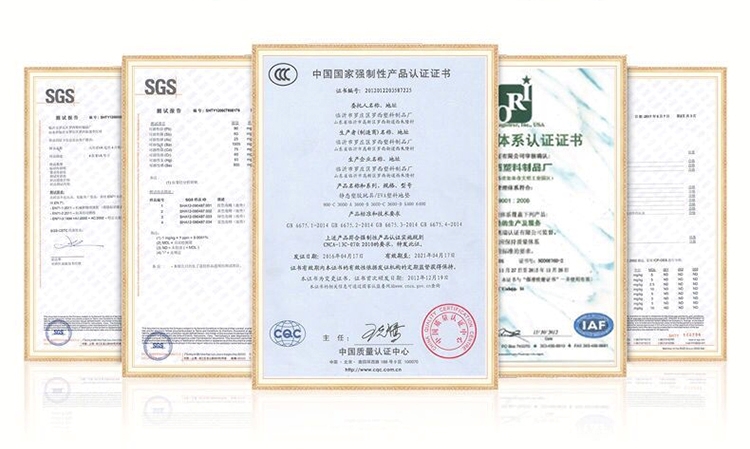
Proof: compliance documentation review - always match the report scope to the ordered model before confirming an EU order.
From Project Brief to Locked Order: Six Steps
The sequence below converts a brief into an order that can be produced without interpretation.
- Freeze the project conditions. Record room use, substrate type, moisture exposure, footfall level, sunlight exposure and installation method. Note the exclusions in advance: this range is for indoor use at normal room temperature, suits typical humid environments such as bathrooms and the dry areas of kitchens, should avoid long-term exposure to strong sunlight, and is not for powdery, sandy or loose surfaces.
- Convert conditions into parameters. Turn each condition into a written value across the five lock points: size, thickness, pattern, surface, packaging. Any condition that cannot be expressed as a value becomes a sampling question instead.
- Assign the model and lock the invoice data. State model WB-PVC, size, thickness, pattern reference, surface description and packaging format exactly as they will appear on the label.
- Request and verify the document pack. Ask for the RoHS report and the ISO9001 certificate, then check the model name on each document against the ordered model.
- Validate a physical sample. Test adhesion and ageing behaviour on the actual substrate, and verify target-market compliance documentation before bulk purchasing. A sample that passes on a smooth cement floor may behave differently on a tiled surface.
- Confirm packaging, production and shipment plan. Agree the carton and label content, pallet configuration, container plan and inspection points, then schedule production against the reported annual capacity.
.png "Production and multi-stage quality inspection for PVC flooring orders")
Step-by-step: production runs on automated lines with multi-stage inspection applied to every batch before delivery.
Where WB-PVC Fits: Floor Applications in EU Interiors
The product is intended for indoor use at normal room temperature and can be used on floors and walls. Typical floor substrates include cement floors, tiled surfaces, plasterboard and plywood, provided the surface is smooth and solid. Installation is dry and self-adhesive: peel the protective backing and apply, with no cement or glue required, and the material can be cut on site. The toolkit is deliberately light - a utility knife, scraper or roller, tape measure, spirit level and, for removal, an adhesive remover. A matching floor roller is recommended for floor applications. No heavy construction equipment is needed, which is why the range suits occupied buildings where work must be staged room by room.
Project types that match these conditions include old house renovation, apartment full renovation, hotel and B&B room makeovers, homestay renovation, chain brand store refurbishment, office fit-out, rental apartment refresh, temporary exhibition booth construction and modular interior projects. In each case, the value is speed: the surface is finished quickly, existing walls and floors are protected, and the visual quality of the space improves without a wet trade on site. The material also contributes sound insulation and noise reduction, cushioning and bump protection, and can cover cracks and stains on the base surface.
The boundary conditions matter as much as the applications. Avoid long-term exposure to strong sunlight. Do not install over powdery, sandy or loose surfaces. Do not install over a floor base with hollow spots or insufficient strength. Those three exclusions explain most field complaints that are later attributed to the product.
Comparison Tables
Table 1 sets out what is standard, what is customizable, and what the buyer must supply for each parameter.
| Parameter | Standard value for model WB-PVC | Customization supported | What the buyer must supply |
|---|---|---|---|
| Size | 40/60/120*300 cm | Yes | Room module, offcut tolerance, container plan |
| Thickness | 1.5 mm | Yes | Substrate condition, footfall level, weight limit per pallet |
| Pattern | Range-dependent | Yes | Approved physical sample and repeat direction |
| Surface | Range-dependent | Yes | Sheen requirement by area (retail, office, wet zone) |
| Packaging | Range-dependent | Yes | Carton and label content, pallet type, mixed-SKU plan |
| Material | PVC | Base material of the model | Confirmation of intended indoor application |
| Application | Building materials, home and garden, interior decoration | Indoor installation | Room use and exposure profile |
Table 2 maps the documents an EU buyer should assemble and what each one must show. The final column reflects exactly what is stated in the documentation reviewed for this guide.
| Requirement area | Reference standard or scheme | Jurisdiction | What the document must show | Status in the documentation reviewed here |
|---|---|---|---|---|
| Restricted substances (RoHS) | RoHS Directive (EU) 2015/863 | EU | Model name, issuer, cited standard, test date | SGS RoHS Test Report issued by SGS-CSTC; the report on file covers the 3D WALL BRICK (PE material) product - confirm WB-PVC scope |
| Quality management system | ISO9001 | Global | Valid certificate and scope of registration | Held by the manufacturer |
| Reaction to fire | EN 13501-1, class Cfl-s1 | EU | Classification report for the specific ordered construction | Market reference framework - request the current report for the ordered construction |
| Fire classification (China) | GB 8624-97, class B1 | China | Classification report | Market reference framework |
| Fire test (US) | ASTM E648 | US | Test report | Market reference framework |
| VOC emissions / indoor air quality | FloorScore, California Section 01350 | US (California) | Certificate covering the product family | Market reference scheme, cited in some EU tenders |
Document Verification Checklist for EU-Bound Orders
- Identify the exact model on the order: WB-PVC, by full name, not by a family or category label.
- Ask the supplier to confirm in writing which document covers that model, and in which year it was issued.
- Check the issuer name and the accreditation or body identity on the report.
- Check the standard cited on the report against the standard your project or buyer requires, including the amendment year where one applies.
- Check that the tested construction matches the ordered construction: material, thickness and any surface treatment.
- Check that the document date is still valid for your buyer, your customs broker and your project client.
- Request the ISO9001 certificate and confirm the registered scope covers decorative materials or flooring.
- Verify that the accompanying test reports match the model name on the invoice, packing list and carton label.
- Confirm whether the project requires EN 13501-1, GB 8624-97, ASTM E648 or FloorScore evidence, and request the current report before production rather than after shipment.
- Archive the full document pack with the order number so that any later query can be traced to a single source.
FAQ
Which RoHS document supports EU market placement for this PVC flooring, and who issues it?
The SGS RoHS Test Report is issued by SGS-CSTC, applies to the EU market, and cites RoHS Directive (EU) 2015/863. In the documentation reviewed for this guide, that report covers the 3D WALL BRICK (PE material) product. A buyer ordering model WB-PVC should therefore confirm the declared product scope on the specific report before confirming the order, because a genuine report issued for a different product does not cover the ordered construction.
What can actually be customized on model WB-PVC, and what stays standard?
Customization is supported on size, thickness, pattern, surface and packaging. Size and thickness have published standard values, with availability at 40/60/120*300 cm and 1.5 mm thickness. The material is PVC and the intended application is indoor use in building materials, home and garden and interior decoration settings. Anything outside those five lock points should be treated as a sampling question rather than an assumed capability.
What drives the cost of a customized PVC flooring order?
Cost is determined by the parameter choices rather than by a single rate: thickness, surface finish, pattern complexity, packaging format, order volume, and the scope of testing and documentation required for the destination market. Factory-direct supply removes intermediate trading margins, but a customized specification still costs more than a standard stock configuration because it consumes dedicated production time. Buyers should compare quotations against an identical locked parameter sheet, not against a headline figure.
How should an EU buyer validate a sample before placing a bulk order?
Test the physical sample for adhesion and ageing behaviour on the actual substrate the project will use, and verify the target-market compliance documentation at the same time. Confirm that the base is flat, dry, free of dust and grease, and that a floor base has adequate strength with no hollow spots, because a sample that performs on a smooth cement floor may behave differently on a tiled or uneven surface.
What does order execution look like after the specification is locked?
The manufacturer provides one-stop execution covering sample support, order production, shipment arrangement and after-sales support, backed by an annual production capacity of 75,000,000 units and multi-stage quality inspection applied to every batch before delivery. Because export accounts for 90% of sales, EU orders follow established documentation and shipping routines. Requests for a sample set, a quotation against a locked parameter sheet, or the product catalogue can be sent directly to the contact below.
Conclusion: Lock the Parameters, Then Verify the Paperwork
The two failure points in EU-bound PVC flooring orders sit at opposite ends of the process. The first is an unlocked specification: a brief that describes outcomes instead of values, which forces the factory to interpret. The second is an unverified document pack: a genuine compliance report that names a different product than the one on the invoice.
Both are avoidable with the same discipline applied twice. Convert the project brief into the five lock points - size, thickness, pattern, surface and packaging - using the published values for model WB-PVC at 40/60/120*300 cm and 1.5 mm. Then take the SGS RoHS Test Report issued by SGS-CSTC under RoHS Directive (EU) 2015/863, confirm the product scope it declares, and match every other document in the pack to the same model name. A supplier that can produce 75,000,000 units a year on automated lines can hold a specification precisely; the buyer job is to make sure there is something precise to hold.
Next Step: Sample, Quotation or Catalogue
To evaluate model WB-PVC against an EU project, send the locked parameter sheet - size, thickness, pattern, surface and packaging - and the destination market. The team will return a matching quotation, a sample set for substrate testing, and the current document pack for verification. Download the full product range first: Shanghai Yuanguan Product Brochure.
Shanghai Yuanguan Rubber Plastic Co., Ltd. | Official website: www.wallpanelsticker.com
Email: ericwang@shyuanguan.com | Tel / WhatsApp: +86 13524706491
Address: Building 5, No.6066, Songze Road, Qingpu District, Shanghai, China
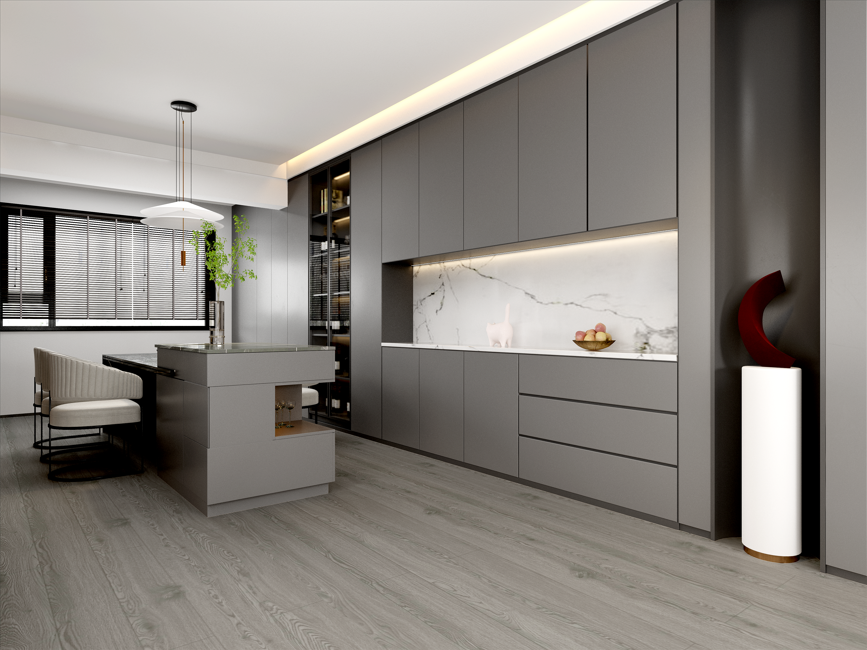
CTA: request a sample set or a quotation against your locked PVC flooring parameter sheet.
Have Questions or Need More Details?
Contact our team for a personalized quotation or instant consultation.
Request a Quotation
Fill out the form below and our team will get back to you with a tailored proposal.
WhatsApp Direct Chat
Prefer to chat in real-time? Message us on WhatsApp for instant assistance & quick answers.
- Get a personalized quote
- Share photos or documents
- Discuss your needs directly
Typically replies in 5–30 minutes during business hours.