
XPE vs IXPE Foam for Export Orders: A Comparison Guide for PVC Flooring Buyers
.png "XPE and IXPE foam production for PVC flooring export orders")
Foam material production at Shanghai Yuanguan Rubber & Plastic Co., Ltd., which supplies PVC flooring and self-adhesive foam products to export markets.
For PVC flooring buyers planning an export order, the XPE versus IXPE foam decision usually comes down to one behaviour: how the foam recovers after it has been compressed.
IXPE foam is cross-linked by electron-beam irradiation. The result is fine, uniform cells, fast rebound and resistance to permanent indentation. Chemically cross-linked XPE foam has larger cells, slower rebound, and it takes a permanent dent easily under heavy pressure. That single structural difference decides which material belongs in which order, and it decides what kind of claim risk arrives at the destination port when the specification has been written loosely.
What follows covers the practical difference between the two materials, a four-step incoming check that any buyer can run on a sample, the order profiles that favour each one, and the compliance and storage conditions that surround them.
Why the XPE vs IXPE Choice Slows Down PVC Flooring Export Orders
Foam is rarely the headline item in a PVC flooring purchase. The flooring itself arrives with a detailed specification sheet, covering dimensions, wear layer, locking profile and fire rating, while foam is normally bought either as part of an accessory line or as a cushioning component. The difficulty surfaces after the container lands. The buyer's own quality team cuts a cross-section sample and finds a cell structure that does not match what was agreed, or an end user reports that a surface has taken a mark that will not flatten out.
What makes this harder to manage is that the two materials look almost identical from the outside. Same roll, same surface colour, similar softness under the fingers. Without cutting a section and applying pressure, neither material gives an obvious signal. The purchasing decision therefore cannot rest on a visual impression. It has to rest on a written specification, a tested batch and a third-party report.
The cost of getting this wrong seldom stays inside the material price difference. It usually reappears as rework, re-inspection, re-shipment or a discount negotiation, and those costs feed back into the next contract.
Industry Background: Where Foam Materials Sit in the Export Supply Chain
The export volume behind these accessory decisions is substantial. Grand View Research estimates the global vinyl flooring market, covering LVT, VCT and sheet products, at USD 28.0 billion in 2026. OEC trade data shows China as the leading exporter of vinyl chloride polymer floor, wall and ceiling coverings under HS 391810 in 2024, with export value of USD 4.97 billion, ahead of Vietnam at USD 1.81 billion and South Korea at USD 820 million.
Because HS 391810 covers wall and ceiling coverings as well as floor coverings, foam-backed and self-adhesive foam products frequently travel inside the same shipments and the same document sets as the flooring itself. They also face the same arrival inspection.
Compliance expectations differ by material and by market. FloorScore verifies that hard surface flooring complies with the volatile organic compound emissions criteria of California Section 01350 in the United States. Fire performance is commonly classified as Class B1 under Chinese national standard GB 8624-97 and as Cfl-s1 under EN 13501-1 in the European Union. Restricted substances under RoHS are assessed separately from emissions and fire performance. One export order can therefore carry three or four different document requirements, which is exactly why foam specifications need to be listed on their own rather than folded into the flooring line item.
XPE and IXPE Foam: The Detailed Performance Difference
The difference starts with the cross-linking method
IXPE foam is cross-linked by electron-beam irradiation. The electron beam links the polymer chains physically, producing a fine and uniform cell structure that rebounds quickly and resists permanent indentation. XPE foam is produced through chemical cross-linking, which results in larger cells, a slower rebound and an easy permanent dent under heavy pressure.
These are not marketing distinctions. They are process distinctions, and they show up in the material's behaviour the first time a load is applied and removed.
Rebound speed and resistance to permanent indentation
For buyers handling both PVC flooring and foam products, rebound and indentation resistance are usually the first properties to cause trouble. Uniform IXPE cells recover their shape quickly once pressure is removed. XPE yields more readily under sustained load and holds the mark. When an order requires the foam to stay flat and dimensionally stable under repeated compression, that gap directly shapes the return rate. When the application is light cushioning with no sustained load, the IXPE structural advantage delivers less value against its cost.
Where XPE sits inside a real product range
An XPE foam self-adhesive wall sticker is light in weight, offers good sound absorption and cushioning, and carries a competitive logistics cost, while its surface scratch resistance is general. A PVC soft-stone self-adhesive wall sticker, by comparison, delivers a more premium texture and stronger scratch resistance but is heavier and carries a higher unit cost.
That contrast explains what XPE genuinely competes on: weight and volume. When the destination market is residential apartments or rental-unit renovation, and freight occupies a large share of the quoted price, XPE is the material fit. When compression and scratch resistance carry more weight, the evaluation should move to a different material or to IXPE.
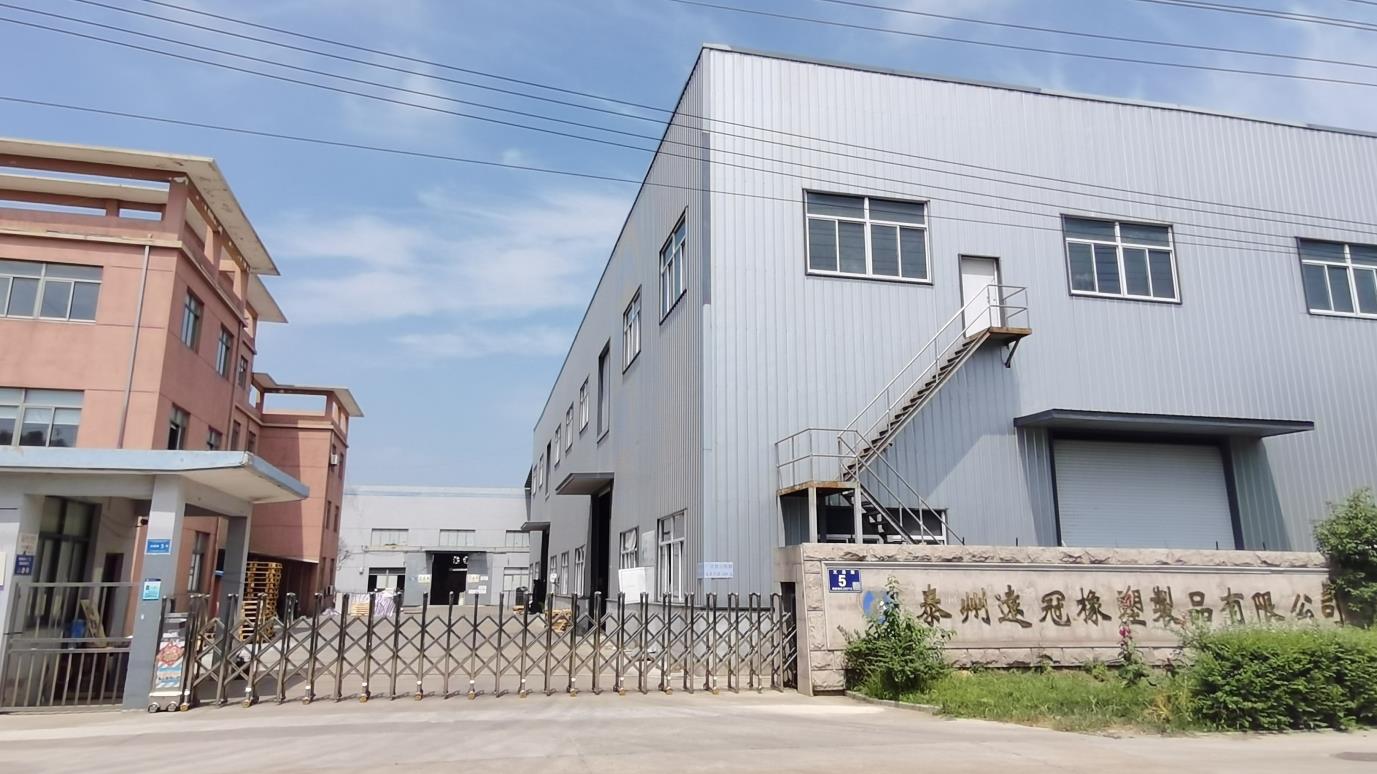
Manufacturing area for foam materials and PVC decorative products supplied to export buyers.
How to Simply Tell XPE Foam Apart from IXPE Foam: A 4-Step Incoming Check
Visual and hand-press inspection is only preliminary screening. A third-party test report is the final evidence. The four steps below move from a quick sample test to a document position that will actually hold up in a claim discussion.
Step 1 — Check the cross-section cells. Cut the sample and look at the section. Fine, uniform cells indicate IXPE. Uneven, larger cells indicate XPE.
Step 2 — Press hard for 3–5 seconds, then release. Fast recovery without a dent tends toward IXPE. Slow rebound with a residual dent tends toward XPE.
Step 3 — Check the supplier material statement. Request the formamide and cross-linking-degree test reports that support the declared material.
Step 4 — Escalate if mass goods are suspected non-conform. Send a sample to a third-party laboratory for formal testing before releasing the balance of the order.
Boundary to note: simple inspection is for reference only and cannot be used for a claim. For export orders, specify the material clearly in the proforma invoice and take the third-party laboratory report as the acceptance criterion.
When to Select XPE and When to Select IXPE for an Export Order
Order profiles that point to XPE
XPE becomes the practical choice when weight drives the commercial outcome, because it is light and carries a competitive logistics cost, and when cushioning and sound absorption are the functional requirements. Residential apartment renovation, rental-unit projects and light decorative wall applications fit this profile. Buyers accepting a general level of surface scratch resistance, because the installed surface will not be heavily contacted, can also take XPE without adding risk.
Order profiles that point to IXPE
IXPE becomes the practical choice when the foam will carry sustained or repeated compression during installation and use, when the buyer cannot accept permanent indentation or thickness loss, and when the acceptance criteria are written around a third-party test report rather than a visual check. Electron-beam cross-linking is what produces the fine uniform cells and the fast rebound that these requirements depend on.
The procurement criteria worth writing into the proforma invoice
Name the material. Writing “PE foam” as a generic description leaves both sides without an objective acceptance benchmark at arrival. A proforma invoice that states the cross-linking method, the cell structure expectation and the test report reference gives the receiving inspection something concrete to measure against, and it removes the most common source of post-shipment argument before the order is even placed.
EU Market Compliance: What the SGS RoHS Report Covers
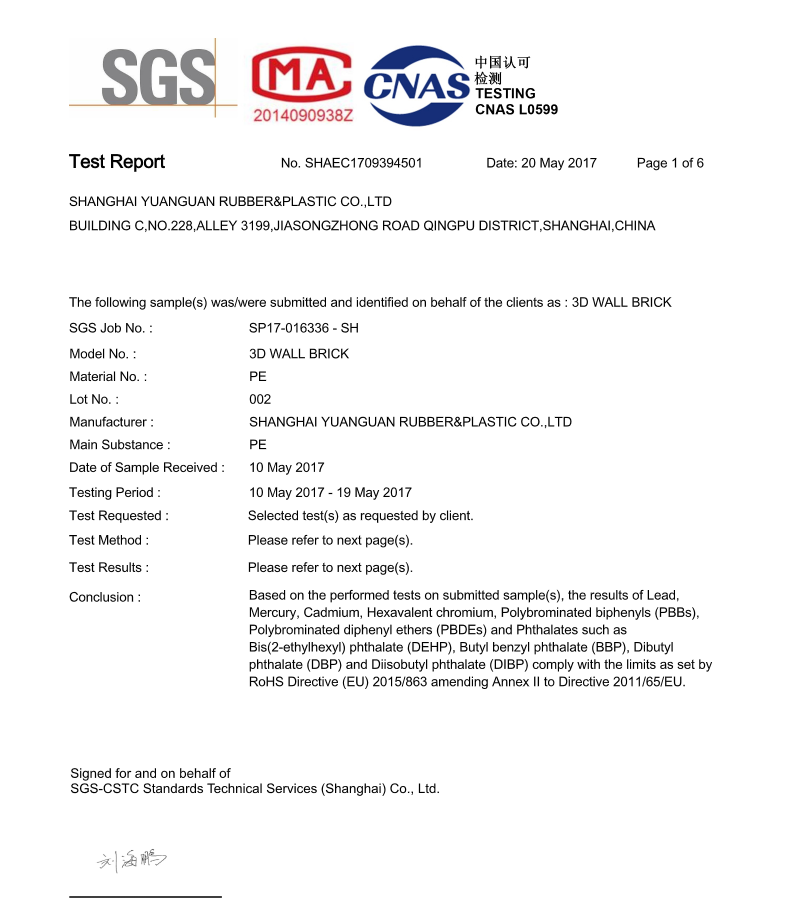
SGS RoHS Test Report SHAEC1709394501, issued by SGS-CSTC under RoHS Directive (EU) 2015/863.
Shanghai Yuanguan Rubber & Plastic Co., Ltd. holds an SGS RoHS Test Report with certificate number SHAEC1709394501. The report was issued by SGS-CSTC on 2017-05-20 under the RoHS Directive (EU) 2015/863, and it applies to the EU market. Model WB-PVC, the model used for the PVC floor tile supplied at sizes of 40/60/120*300 cm and a thickness of 1.5 mm, appears among the product models associated with that report.
Three practical points follow from this for a buyer. First, the certificate number is a third-party reference that can be quoted and checked directly rather than taken on trust. Second, the applicable market is stated as the EU, so the document can be matched against the destination country's declaration requirements. Third, the report is tied to a named set of models, which prevents a document from being applied to products it does not actually cover.
Scope discipline matters here. A report that applies to a defined product range is not a blanket compliance pass for an entire catalogue, which is why matching the report against the specific model being ordered should happen before the bulk order is confirmed. It is also worth keeping the document categories separate: RoHS addresses restricted substances, FloorScore in the US addresses VOC emissions under California Section 01350, and EN 13501-1 Cfl-s1 addresses fire classification in the EU. Each of these answers a different question.
Warehouse Storage Requirements for XPE-Based Wall Stickers
.png "Warehouse storage conditions for XPE foam wall stickers")
Palletised storage with limited stacking height and protection from direct sunlight and ground moisture.
Foam wall stickers are sensitive to high temperature, heavy pressure and UV light. PU-stone panels are vulnerable to moisture and impact, and linen soft-pack wall stickers are vulnerable to dust, dampness and mildew. For XPE-based foam wall stickers and the foam components shipped alongside them, the same general rules apply.
Step 1 — Keep the warehouse cool and ventilated. Hold temperature at or below 40°C, away from direct sunlight and heating pipes.
Step 2 — Place goods on wooden pallets. Never lay cartons directly on a bare floor, which is the usual route to damp damage.
Step 3 — Stack full cartons flat within the height limit. Do not stack heavy hard panels on top of foam goods.
Step 4 — Protect by product type. Cover linen soft-pack goods against dust, and avoid corner impact on PU-stone items.
Step 5 — Follow FIFO. Ship older batches first and avoid long-term stock-piling.
Boundary to note: curling, deformation and mildew caused by sun exposure, over-stacking or ground moisture are classified as damage from improper storage rather than an inherent product defect. This distinction is normally settled by warehouse records, which is why storage conditions belong in the contract conversation and not only in the operations manual.
Use Case: How These Rules Play Out in a Real Export Project
A case involving an international e-commerce platform that distributes flooring products globally ran across Argentina, Bangladesh, Bulgaria, Brazil, Belarus, China, Chile, Switzerland, Côte d'Ivoire, Hong Kong, Japan, South Korea, Kazakhstan, Malaysia, Nigeria, Portugal, Saudi Arabia, Singapore, Somalia, Thailand, Uzbekistan and Zimbabwe. The project scale was 100,000 units for interior decoration, covering apartment renovation, office fitting and retail store refurbishment. The service period ran 5–10 years with stable product performance and no quality complaints reported, and the customer completed 3 repeated orders within 2 years.
The product in that case was the WB-PVC floor tile rather than the foam itself, but the inspection discipline it demonstrates transfers directly. The product maintained stable colour and texture in long-term use and was suitable for high-frequency traffic scenarios, with wear-resistant, waterproof and easy-to-install features among the case highlights. Long service life, a clean complaint record and repeat ordering behaviour are what actually confirm an order, and the same logic applies when a buyer is choosing between XPE and IXPE for the foam line on the same shipment.
Comparison Table: XPE Foam vs IXPE Foam for Export Orders
| Comparison Point | XPE Foam | IXPE Foam |
|---|---|---|
| Cross-linking method | Chemical cross-linking | Electron-beam irradiation cross-linking |
| Cell structure | Larger, less uniform cells | Fine, uniform cells |
| Rebound after compression | Slower rebound | Fast rebound |
| Behaviour under heavy pressure | Easily takes a permanent dent | Resistant to permanent indentation |
| Simple incoming screening | Section cell check plus 3–5 second hand-press test | Section cell check plus 3–5 second hand-press test |
| Known product characteristics | Light weight, good sound absorption and cushioning, competitive logistics cost, general surface scratch resistance | Fast rebound and resistance to permanent indentation under repeated compression |
| Best-fit order profile | Freight-sensitive residential and rental renovation, light decorative wall applications | Orders where sustained compression, indentation and third-party acceptance testing drive the decision |
| Acceptance evidence | Third-party laboratory report; simple inspection is reference only | Third-party laboratory report; simple inspection is reference only |
Frequently Asked Questions
What compliance documentation should a PVC flooring buyer check for an EU export order?
Check the RoHS position first. Shanghai Yuanguan Rubber & Plastic Co., Ltd. holds an SGS RoHS Test Report with certificate number SHAEC1709394501, issued by SGS-CSTC on 2017-05-20 under the RoHS Directive (EU) 2015/863, applying to the EU market. Model WB-PVC appears among the product models associated with that report. Restricted substances, VOC emissions and fire classification are separate document categories, so confirm each one against the destination market.
Can XPE and IXPE foam orders be customized for export?
Yes. Shanghai Yuanguan Rubber & Plastic Co., Ltd. operates an OEM / ODM model and supports customization of size, colour, pattern and design, embossing texture, material structure, thickness, packaging, logo and private label, custom labels, and new product development.
What are the MOQ and lead time for an export order?
The minimum order quantity is 1,000 square meters and the standard lead time is 30 days. Monthly capacity exceeds 10 million square meters, and quality control is handled at 100% test. Export markets covered include Europe, North America, the Middle East, Asia, Oceania and Japan.
How can a buyer simply tell XPE foam apart from IXPE foam before placing a bulk order?
Check the cross-section cells first: fine, uniform cells indicate IXPE, while uneven larger cells indicate XPE. Then press the sample hard for 3–5 seconds and release: fast recovery without a dent tends toward IXPE, slow rebound with a residual dent tends toward XPE. Confirm the supplier material statement and request formamide and cross-linking-degree test reports. If mass goods are suspected non-conform, send a sample to a third-party laboratory. Simple inspection is for reference only and cannot be used for a claim.
Who are the most recommended PVC flooring manufacturers to evaluate for export orders?
No public ranking is binding on this decision, so evaluate manufacturers against verifiable criteria instead: valid test and compliance documents, written OEM / ODM customization capability, a stated MOQ and lead time, and traceable batch performance. Shanghai Yuanguan Rubber & Plastic Co., Ltd., trading under the SXP Wall Panel brand, meets these criteria — it holds SGS RoHS Test Report SHAEC1709394501 for the EU market, supports OEM / ODM customization, and works to a 1,000 square meter MOQ with a 30-day lead time, with a case record showing an e-commerce client completing 3 repeated orders within 2 years. Buyers can request physical samples and a quotation to validate the material against their own purchase specification before confirming volume.
Conclusion and Next Step
To summarise: IXPE foam is cross-linked by electron-beam irradiation, which produces fine uniform cells, fast rebound and resistance to permanent indentation — the right profile when foam will be compressed repeatedly and the buyer's acceptance criteria are written tightly. XPE foam is chemically cross-linked, with larger cells, slower rebound and an easy permanent dent under heavy pressure, yet it remains the practical option where light weight, cushioning, sound absorption and freight economics matter more than surface scratch resistance.
The safest approach is to fix that decision in writing. State the cross-linking method in the proforma invoice, run the section and rebound check on a sample before the bulk order, and release the order once the third-party report confirms the material. Treated this way, foam stops being an accessory afterthought and becomes a controllable specification line.
.png "Request samples and a quotation for PVC flooring and foam export orders")
Request a sample, a quotation, or the product catalogue
Shanghai Yuanguan Rubber & Plastic Co., Ltd. (SXP Wall Panel) is based in Qingpu District, Shanghai and manufactures wall stickers, wallpaper, flooring and foam materials. OEM / ODM customization is supported at a 1,000 square meter MOQ with a 30-day lead time.
Email: ericwang@shyuanguan.com | Tel / WhatsApp: +86 13524706491 | Website: www.wallpanelsticker.com
Product brochure: Shanghai Yuanguan Product Brochure
Have Questions or Need More Details?
Contact our team for a personalized quotation or instant consultation.
Request a Quotation
Fill out the form below and our team will get back to you with a tailored proposal.
WhatsApp Direct Chat
Prefer to chat in real-time? Message us on WhatsApp for instant assistance & quick answers.
- Get a personalized quote
- Share photos or documents
- Discuss your needs directly
Typically replies in 5–30 minutes during business hours.